
About the Conference

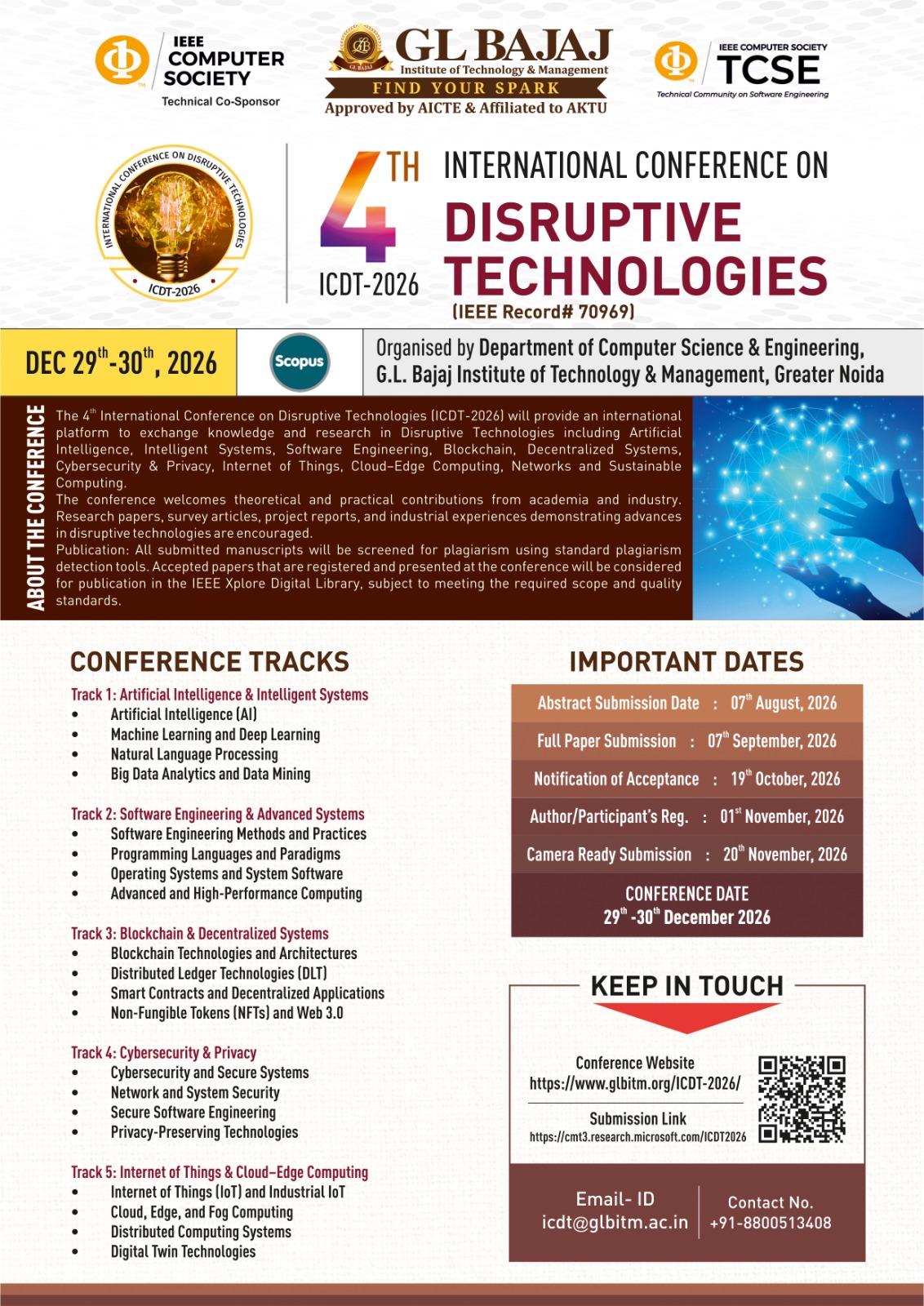
The 4th International Conference on Disruptive Technologies (ICDT-2026) will provide an outstanding international venue for exchanging knowledge and achievements in Disruptive Technology using AI, Blockchain, IoT, Augmented Reality, 3D Printing & Machine Learning with their Theory, Methodology, and applications. The conference seeks contributions in both theoretical and practical aspects to the multi-disciplines of Artificial Intelligence, Machine Learning and Data Analytics.
The Conference's goal is to bring together scholars and practitioners from academia and industry to discuss and exchange cutting-edge developments in the field. Articles illustrating research results, projects, surveying works, and industrial experiences that describe significant advances in the areas of Disruptive Technologies are encouraged to be submitted to the conference. Authors, research scholars and industry practitioners are solicited to contribute to the conference by submitting their original, unpublished high quality work that describe the significant advancement in the area of Information retrieval, IoT, Artificial Intelligence, Mechatronics, data visualization but not limited to
- Intelligent System Architectures
- Knowledge Representation
- Knowledge-based Systems
- Mechatronics
- Multimedia & Cognitive Informatics
- Neural Networks
- Parallel Processing
- Pattern Recognition
- Pervasive Computing and Ambient Intelligence
- Programming Languages Artificial Intelligence
- Soft Computing and Applications
- Artificial Intelligence Tools & Applications
- Automatic Control
- Bioinformatics
- Natural Language Processing
- Computer Vision and Speech Understanding
- Data Mining and Machine Learning Tools
- Fuzzy Logic
- Heuristic and AI Planning Strategies and Tools
- Computational Theories of Learning
- Hybrid Intelligent Systems
- Recent Trends and Developments
- Robotics
- Fuzzy Systems
- Neural Networks
- Machine Learning
About the Institute
G. L. Bajaj Institute of Technology and Management is the 6th Institute established under the prestigious banner of Rajeev Memorial Academic Welfare Society (Registered Under Societies Registration Act 1860). The institute is approved by All India Council for Technical Education (AICTE), Ministry of HRD, Govt. of India and Affiliated to Dr. A.P.J. Abdul Kalam Technical University (Formerly UPTU Lucknow). G. L. Bajaj Institute of Technology and Management is one of the quality driven Educational Institute in the Greater Noida/Delhi-NCR Region. GLBITM stands out as one of the best engineering and management Institute in Uttar Pradesh. It also stands out in its approach to assist and equip the students for their overall development, giving them a strong foundation for a successful future. The institute offers B.Tech, MBA and MCA programs.
This self financed institute is governed by Rajeev Memorial Academic Welfare Society (Registered Under Societies Registration Act 1860). It is approved by All India Council for Technical Education (AICTE), Ministry of Human Resource Development, Government of India and affiliated to Dr. A.P.J. Abdul Kalam Technical University, Lucknow.
The institute has been maintaining its positions amongst the top engineering and management colleges in AKTU university results. It has been maintaining the highest pass percentage amongst the engineering and Management colleges in Noida and Greater Noida region under Dr. A.P.J. Abdul Kalam Technical University, Lucknow for the last eight years and is listed among the top engineering and management colleges in Greater Noida, Delhi NCR. In fact this engineering college has been listed among the top engineering of India by NIRF, issued by MHRD, Government of India. The Institute has also received awards for being one of the top engineering and management institutes of North India and UP by many organizations.
About the CSE Department
The Department of Computer Science & Engineering at G. L. Bajaj Institute of Technology and Management, established in 2005, was founded with a clear vision—to contribute meaningfully to the rapidly expanding IT industry and to meet the global demand for skilled and adaptable software engineers. Over the years, the department has grown in strength, capacity, and reputation, particularly during the last decade, which has witnessed unprecedented technological advancement and innovation. These developments have propelled the department to take significant strides in academic excellence, contemporary curriculum design, and student development, making it one of the most distinguished and preferred departments within the institute.
From its inception, the department has focused on nurturing technically competent professionals equipped with modern computing skills and the ability to adapt to evolving technological landscapes. It continuously updates its academic content, teaching methodologies, laboratories, and research initiatives to align with emerging trends in computing. With an emphasis on both theoretical foundations and practical applications, the department ensures that students gain a strong grounding in areas such as algorithm design, system programming, artificial intelligence, data science, software engineering, and computer networks.
Computer Science & Engineering, being the flagship branch of engineering, holds a central position in driving innovation and discovery. The department encourages students to engage in scientific research, hands-on programming, and software development through well-structured academic programs, project-based learning, and industry collaborations. By promoting analytical thinking, creativity, and problem-solving abilities, it prepares students to thrive in diverse professional environments, including academia, software development, research organizations, and emerging technology sectors.
Overall, the Department of Computer Science & Engineering at G. L. Bajaj Institute of Technology and Management remains committed to producing globally competent engineers and contributing to the progress of the IT industry. Its forward-looking approach and dedication to excellence ensure that graduates are well prepared to meet the challenges and opportunities of the future.
Conference Tracks
The research papers are invited in the following tracks and areas but are not limited to.
Track 1: Artificial Intelligence & Intelligent Systems
- Artificial Intelligence (AI)
- Machine Learning and Deep Learning
- Natural Language Processing
- Generative AI and Foundation Models
- Big Data Analytics and Data Mining
- Explainable, Ethical, and Responsible AI
- AI in Education and AI for Social Good
Track 2: Software Engineering & Advanced Systems
- Software Engineering Methods and Practices
- Agile, DevOps, and MLOps
- Programming Languages and Paradigms
- Operating Systems and System Software
- Advanced and High-Performance Computing
Track 3: Blockchain & Decentralized Systems
- Blockchain Technologies and Architectures
- Distributed Ledger Technologies (DLT)
- Smart Contracts and Decentralized Applications
- Non-Fungible Tokens (NFTs) and Web 3.0
- Zero-Knowledge Proofs
- Cryptography and Data Encryption
Track 4: Cybersecurity & Privacy
- Cybersecurity and Secure Systems
- Network and System Security
- Secure Software Engineering
- Privacy-Preserving Technologies
- Digital Forensics and Cyber Threat Intelligence
Track 5: Internet of Things & Cloud–Edge Computing
- Internet of Things (IoT) and Industrial IoT
- Cloud, Edge, and Fog Computing
- Distributed Computing Systems
- Digital Twin Technologies
- Smart Cities, Smart Healthcare, and Smart Industry
Track 6: Networks & Sustainable Computing
- 5G and 6G Communication Networks
- Intelligent Communications and Networking
- Quantum Computing and Post-Quantum Technologies
- AR/VR and Human-Centric Computing
- Green ICT and Sustainable Computing
- Industry 5.0 and Sustainable Digital Transformation
- Robotics and Intelligent Autonomous Systems